Security in Kelowna is oddly specific. A brewery on Richter needs visibility after hours, the front desk at a medical clinic must close off controlled drug storage between shifts, a car dealership wants airflow through the service bay while locking the perimeter, and a strata council tries to keep downtown parkade trespassers out without turning the building into a bunker. Expanding security gates hit that sweet spot where you can secure an opening quickly, still see what is going on, and avoid the heavy civil scope of a solid wall or a motorized grille. They collapse to a neat stack, run on a track or floor casters, and can be keyed alike across a portfolio. That versatility is why contractors get asked for them, usually with the dreaded instruction: “Make it secure, but don’t make it ugly.”
This is a practical guide for Kelowna contractors and project managers who need to specify, quote, and install expanding security gates without headaches. We will talk terminology, measurements that actually matter, load paths, hardware that will not drive you back to site three times, and the little local realities of Okanagan winters, mixed-use buildings, and AHJ quirks. Along the way we will use the industry’s favorite aliases, because your client may say accordion security gates, scissor security gates, or commercial security gates, and they usually mean the same general family of products.
What you are really buying when you buy a gate
The expanding gate itself is just one piece. You are buying a system that relies on a substrate, a track, a lockset, and some honest conversation about how people will use it at 2 a.m. when everyone is tired.
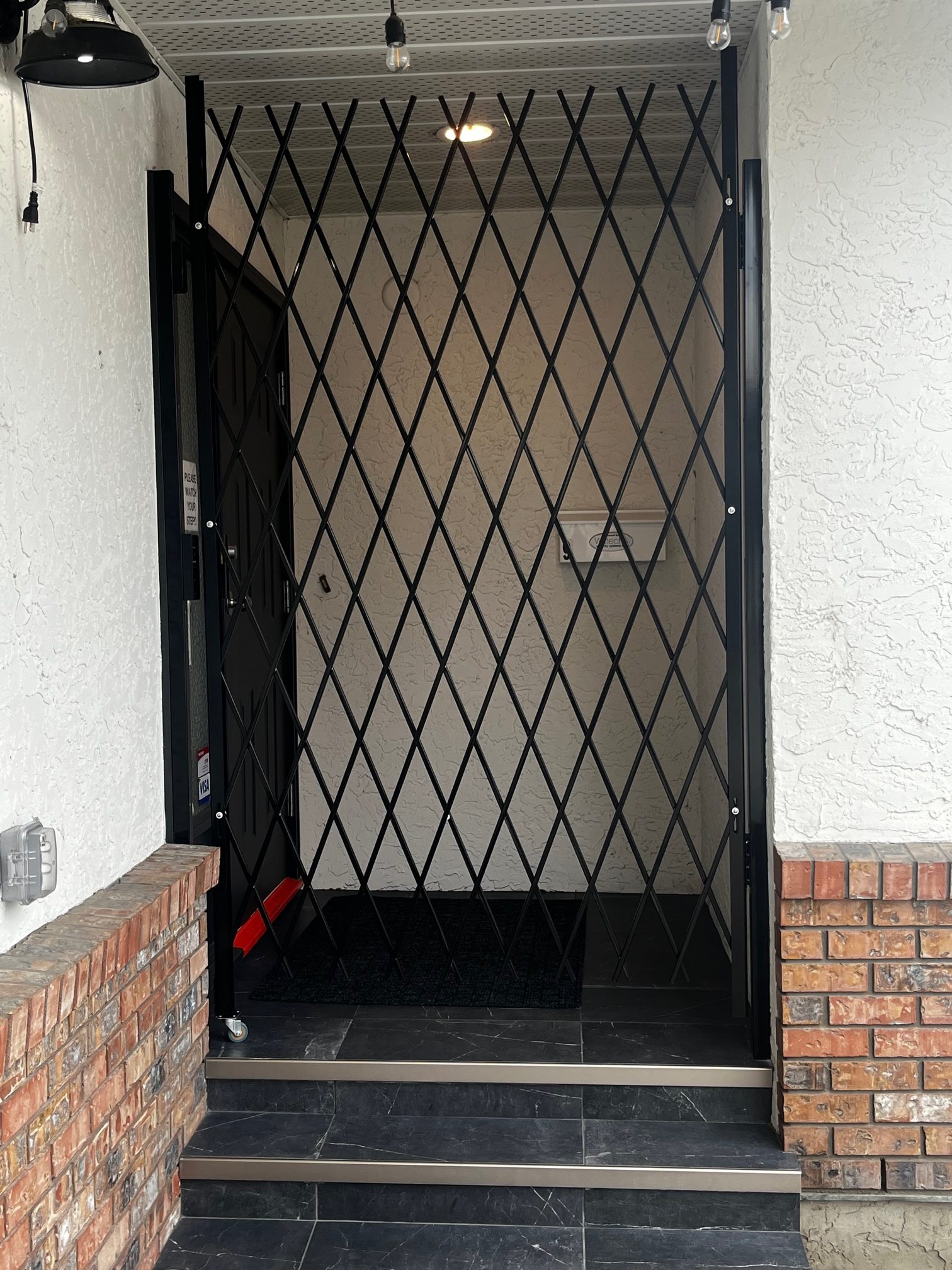
Most accordion security gates use riveted or welded steel lattice with vertical members and scissor-style crossbars. Better models use galvanized steel with a baked enamel or powder coat. Aluminum exists, and it is lighter, but it deflects more under pry load and needs thicker sections to compete with steel. If the client wants white in a sunny storefront, remember that powder coat over galvanizing outlasts a simple enamel finish when exposed to UV and sidewalk salt spray. In Kelowna, sidewalk salt is not Winnipeg-level, but you will still see magnesium chloride tracked in all winter on Bernard and Pandosy. If the opening is near grade, a galvanized core with a poly powder coat earns its keep by year three.
The track is either overhead, bottom-rolling, or both. Overhead-only looks cleaner and keeps floors clear for dollies and ADA compliance, but the head needs reinforcement. Bottom-rolling puts casters on the floor and often skips the ceiling reinforcement, yet it creates a trip line and collects grit. Contractors here usually choose overhead for storefronts and bottom-rolling for warehouses, parkade alcoves, and rough CMU corridors where a steel angle at the head would be a pain to anchor.
Locks come in three common flavors: padlock hasps, built-in slam locks with cylinder, and interlocks that tie into a building’s access control. Padlocks are cheap and rugged, but end users lose them. Slam locks look professional and can be keyed to your client’s master system, which matters for multi-site retail or a property manager who never wants to carry six rings of keys. If you tie into access control, confirm the fire life safety implications and power routing. Security gates for business do not exist in a vacuum. If the gate becomes part of the egress path, the building official will have opinions.
Clearing the fog on terms that get mixed up
Clients will say “rolling grille,” “folding grille,” “scissor gate,” and occasionally “roll-up door” when they mean expanding security gates. A true rolling grille coils into a barrel above and needs pipe, motor, and a structural tube to mount. Awesome for malls, overkill for a 7 foot tenant back door. A folding grille is usually an aluminum tambour system with continuous top and bottom tracks, better for wide storefronts in shopping centers. An expanding or scissor security gate is the steel lattice that stacks to the side. When your client says accordion security gates, they are pointing at the scissor lattice.
Among scissor security gates, note two broad categories. Single-fold gates stack to one side and hinge off a single jamb. Bi-parting gates split in the middle, each leaf stacking to a jamb. Bi-parting is tidier on wide openings because the stack widths are halved and the lock engages at center. Single-fold is faster to install and cheaper in narrow doorways.
The numbers that matter before you order
Expanding security gates masquerade as forgiving products. They are, up to a point. Measure wrong and you will own a custom gate that binds or leaves a gap you can drive a prybar through.
Height. Measure finished floor to underside of the head track. Do it at both jambs and at center. Floors and ceilings are not level, especially in older Kelowna buildings where renovations have layered finishes. If the head is out of level by more than 6 millimeters across the opening, plan for a shimmed track and a clean reveal trim to hide the wedge. Aim to order a gate height 20 to 40 millimeters less than the tightest spot to avoid binding. Tight to the floor looks secure, but the bottom pickets will scrape concrete dust and seize.
Width. Measure clear opening between finished jamb faces. For single-fold gates, confirm hinge clearances. For bi-parting, ensure both sides can accept stack depth. If the opening has a baseboard or bumper at the bottom only, your gate will pinch at the bottom and wave at the top. Either remove the obstruction in the stack zone or build out the jamb with steel tubing to create a flat plane.
Stack. Every foot of gate adds stack depth. A rough rule: stack depth equals 10 to 15 percent of the opening width, depending on the model and picket spacing. For a 10 foot opening, expect 12 to 18 inches of stack. That stack steals daylight. On a storefront with narrow sidelights, daylight loss matters, so consider bi-parting to split the impact.
Pickets and lattice spacing. Common picket centers are 3 inches, 5 inches, and 7 inches. Tighter spacing looks more secure and resists hand reach-ins, important for high-value displays. Wider spacing stacks tighter and costs less. If the client stores liquor, vapes, or anything in plain view, err toward tighter centers. Some security gate supplier catalogs claim tool resistance with wide spacing, but an arm through a 7 inch lattice can still reach a handle.
Projections and obstructions. Fire pull stations, door closers, and the protruding granite sill the millworker is so proud of will all live right where your gate wants to stack. Walk the site and take photos. On one downtown tenant improvement, we found a sprinkler head dead center at the head where the track wanted to mount, installed years earlier to cover a display niche. The gate track needed a drop bracket to clear the head by 50 millimeters. That note in the submittal saved a testy after-hours conversation with the sprinkler fitter.
Substrate. A light gauge steel stud behind gypsum is not a structure. Gates produce torsion at the hinge jamb and shear at the lock jamb. If you anchor into hollow wall, plan to reinforce with continuous 10 gauge steel backing or a tube steel jamb that you lag into structure above and below. Concrete and CMU are your friends, but in older block walls soft mortar will strip tapcons. Use mechanical anchors rated for shear, not just tension, and set a minimum embedment the manufacturer warrants. In wood, lag into solid studs or add a continuous nailer.
Egress, fire, and the dreaded inspector question
The fastest way to get stuck with a non-compliant install is to block an exit with a locked gate. In commercial spaces, any opening used as a means of egress must be openable from the egress side without keys, tools, or special knowledge. If your security gate sits in front of a public exit door, the inspector will ask how it releases. If your plan is “the staff unlock it at night,” you will not pass.
There are workable options. Put the gate inside the vestibule so the exterior door serves as the egress barrier and the gate secures the vestibule contents. Use a free-egress lock on the gate with a thumbturn and a keyed exterior, then tie it into a contact for the alarm. For mall or clinic corridors, specify a breakaway feature or a fail-safe maglock controlled by the fire alarm, provided the AHJ is comfortable with the gating of a corridor in the first place. In parkades, gates usually divide tenant areas, not egress paths. Still, confirm the path of travel and sight lines to exit signage. Kelowna Fire Department will check that the gate does not create a confusing dead end.
If you plan to electrify anything, from strikes to maglocks, coordinate with the electrical permit early. The delta between fail-safe and fail-secure matters. Most egress paths require fail-safe so the gate unlocks on power loss or fire alarm. But fail-safe means someone could pull power and defeat it. Balance that with monitoring contacts and cameras, or keep the gate purely mechanical in non-egress openings.
Surface finishes that survive the Okanagan
The Okanagan gives you hot, bright summers and freeze-thaw winters. Exterior gates on Lake Country storefronts fade and chalk faster than interior mall gates. Powder coat in a light, non-metallic color hides dust and fingerprints better than high-gloss black. If the client insists on black, propose a fine-texture powder, which resists scuffing and hides touch-ups. Galvanized base metal is worth the money for exterior or quasi-exterior environments like open parkades with road spray.
Inside food production or washdown areas, stainless is tempting. For expanding security gates, stainless costs jump sharply and the alloys used will still show tea staining near welds. A better approach is galvanized steel with a marine-grade powder coat. Check the hardware. Zinc-plated fasteners are fine indoors, but use stainless fasteners and nylon washers near exterior doors.
Hardware that prevents call-backs
Choose tamper-resistant through-bolts where you have access to the opposite face of a jamb. If you only have one-sided access, use sleeve anchors or wedge anchors rated for shear, and add adhesive where the manufacturer approves it. For hinge pivots, look for stainless steel shoulder bolts with nylon bushings rather than bare steel on steel. A squeaky hinge on a quiet street at 1 a.m. is a neighborhood complaint generator.
For locks, favor a slam lock with a hardened steel throw and a shrouded keep. Key it into the client’s existing system where possible. If they have a small master key system, ask for the keyway and pinning chart ahead of time so your security gate supplier can prep cores, or plan to swap cylinders after delivery. If the client wants padlocks, specify shrouded hasps and a lock body with a boron shackle. Weak padlocks invite bolt cutters and bad publicity.
On gates wider than 12 feet, add a positive floor stop at the lock jamb so the leaf cannot be rammed into the jamb and bounce back to relieve the lock. In parkade installs, specify a removable pin at the bottom of each leaf so maintenance can pull the gate off quickly for equipment access.
When to pick bottom-rolling, overhead, or hybrid
Overhead-only gates are elegant. The lattice glides, no floor hardware to trip on, and housekeeping is simple. You need good head support. If the head is drywall over 25 gauge track, add a continuous steel angle or tube anchored into the structure above. On a steel lintel or concrete beam, overhead is ideal.
Bottom-rolling shines in warehouses and retail back rooms where the head is an old bowed glulam or spalled concrete with too much variance for a clean track line. A bottom track with fixed stops makes alignment easier for an uneven head. Make sure the floor is flat enough. Expansion joints and chipped slabs will turn rollers into speed bumps. Grind and patch as a line item rather than pretending the issue will disappear behind the gate.
Hybrid tracks exist with overhead guidance and hidden mini-casters that carry some load, a compromise for questionable structure. They roll smoothly and hide wear better than pure bottom-rolling. The cost delta is modest relative to the labor saved during install.
Spec decisions that affect real security
Security is not just steel thickness, it is how the system behaves under attack. A thief with a five-minute window will try to pry a lock jamb, cut a lock, or lift the lattice to create a crawl-under gap.
Lock area reinforcement. Specify a formed steel lock pocket and a keep that nests into a jamb receiver. Thin angle iron at the jamb invites a crowbar. A good keep sits proud of the jamb and embraces the lock throw, spreading load into the jamb rather than concentrating at a single screw.
Bottom grab point. Leave too much floor gap and you create a handhold. For most interiors, a 25 to 40 millimeter gap is ideal. If clients insist on tighter, warn them that debris will jam the bottom bars over time. In exterior applications where snow and grit collect, tolerate a little more gap and add a bottom https://penzu.com/p/2ead9629f9fc15e4 kick plate that discourages reach-under.
Picket material and spacing. When a display sits inches behind a gate, aim for tighter lattice and horizontal members that resist spread. Crossbars that rivet through pickets hold shape better than face-mounted alternatives. Welded intersections feel robust, but quality varies wildly. A reputable security gate supplier in the expanding security gates Kelowna market will show real samples with clean welds, not catalog glamour shots. Ask to see one. You can tell inside of thirty seconds which lattice will rack under a pry.
Fastener pattern. Use more than minimum anchors at the hinge jamb. The first few grabs and shoves always test the hinge line. On CMU, drill staggered anchor pattern to avoid vertical crack lines. Add a continuous backer where you can.
Real project scenarios in Kelowna
A Pandosy wine shop wanted commercial security gates that preserved visibility. The challenge: a gorgeous inline storefront with a narrow pilaster where the stack would sit, and a copper countertop just inside. A single-fold gate stacked on the right would have blocked product. The solution was a bi-parting overhead gate with powder-coated lattice to match the mullions. The head track attached to a newly added steel tube hidden behind the bulkhead, and both stacks tucked neatly behind columns. The lock engaged at center with a keep that spanned between two narrow pilasters. Daylight preserved, security improved, no countertop interference.
A lakeview clinic needed to lock a pharmacy alcove after hours without blocking an egress corridor. The architect had drawn a rolling shutter. The lintel could not take a shutter barrel without a structural rework. We changed to an overhead expanding gate within the alcove opening, free-egress thumbturn inside and keyed outside, plus a contact tied to the alarm. The inspector cared about egress. We kept the gate inside the pharmacy boundary so the corridor remained clear. The clinic avoided a messy lintel rebuild and saved two weeks.
A parkade in a mixed-use building near Ellis had a bike room plagued by theft. The original chain-link cage with a hasp was a joke. We specified a bottom-rolling scissor gate that aligned to the slaggy slab with shims under the track, a shrouded lock, and a steel angle receiver that spread force. Cameras already covered the door, so visible deterrence mattered as much as raw strength. Theft dropped, and the strata finally stopped looping a motorcycle chain around the old door like a DIY fix.
Installation tips from callbacks you can skip
Pre-drill everything and dry-fit the gate before paint touch-ups or final flooring. Lattice gates can surprise you with how they sit once weight is on track. If you are doing a tenant improvement with a tight turnover, store the gate on site only after dusty work is done. Grit gets into pivots and rollers fast.
Mark swing or slide path in tape and walk the path with end users. Someone will point out the garbage can, sanitizer stand, or aesthetic plant that always sits right where the gate needs to move. Solve it before hardware goes on the wall.
If using a bottom track in a retail space, set the track with countersunk anchors and add a neat beveled transition with epoxy mortar. Nothing sours a store manager’s mood like a lip that flips a dolly loaded with cases. On polished concrete, talk to the finisher about color-matched patch material before you drill. You do not want bright gray pucks in a mocha slab.
Seal exterior penetrations. On a lakeside façade with prevailing wind, water finds screw threads and wicks into drywall behind. A small tube of polyurethane sealant saves a lot of finger pointing later.
Most brands come with sheet metal screws for convenience. Throw half of them away. On metal jambs, use machine screws with rivnuts. On wood, pilot drill and use structural wood screws with a long thread and washer head. The gate’s life depends on the anchor, not the brochure.
Maintenance the client will actually perform
Present a simple schedule. Every six months, vacuum the track, wipe lattice with a damp cloth, and hit pivot points with a dry lube. Avoid greasy sprays that turn dust into grinding compound. Every spring, check anchor tightness at the hinge jamb and the lock keep, especially in parkades where vibration from traffic loosens fasteners.
Key management stops more lockouts than hardware ever will. If you provide a slam lock keyed to A2 or Schlage C, get at least two extra cores pinned to the client’s system and hang onto the change keys during the turnover. For padlock systems, insist on at least two locks keyed alike and a lockbox on site. One downtown boutique used a single padlock for their gate and tossed it in a drawer. It got borrowed for a delivery truck and vanished. The manager cut her own gate with bolt cutters in a panic the next night and then called for warranty. Avoid the foreseeable drama.
Costs, lead times, and what is reasonable to promise
Price fluctuates with steel and coatings, but a single-fold expanding gate for a 36 inch door opening with a slam lock typically lands in the low thousands installed, depending on substrate work. Wider storefront gates with bi-parting leaves and powder coat climb from there. Custom colors add a few hundred dollars. Electrical work for an access-controlled solution adds more than the gate itself in many cases, so be candid about that line item. Clients often forget that permits and a certified electrician come with card readers and maglocks.
Lead times for standard finishes range from two to six weeks, longer if the factory is pushing big mall orders or doing custom color. Local security gate supplier inventories in the Okanagan are spotty for anything except basic sizes. If your schedule is tight, call the supplier before you promise dates. Shipping to Kelowna is quick from the Lower Mainland, but winter storms can stack up delays on the Connector. Plan your install dates with a little buffer rather than the day before opening.
Choosing a security gate supplier who will pick up the phone
Most suppliers can sell you steel. You want one who will stand on site with a tape, notice that crooked lintel, and recommend the right track. In the expanding security gates Kelowna market, prioritize a supplier who:
- Brings physical samples and finish chips so the client sees the real thing, not a PDF. Provides shop drawings with stack zones, fastener types, and weights, not just an overall width and height. Has a service technician who covers the Okanagan regularly rather than “we come up when we have a few calls.” References jobs you can quietly swing by, like a storefront gate on Bernard or a bike room gate in a nearby strata. Carries replacement parts and compatible cylinders, not just full units.
That short list will save you time and protect your reputation. The best suppliers will tell you when a gate is the wrong tool. On a few jobs, we swapped to a rolling grille or a steel mesh door because the opening needed full height security and daily motorized use. Those conversations build trust.
Design details that keep architects and brand managers happy
Security gates for business succeed when they blend with the façade and vanish during the day. Align the lattice color with mullions. If the client has a refined brand palette, order a custom powder coat that matches RAL or a paint sample. Hide the head track behind a slim valance that matches the bulkhead, or integrate the track into a shadow line. Keep the lock keep neat with a formed receiver rather than a raw angle.
Mind sight lines. A bi-parting gate with central lock can sit behind a mullion and disappear when stacked. For a boutique, configure stack to the side with less merchandising traffic. If a pilaster is too narrow for the stack, recess a pocket. It only takes 150 to 200 millimeters of pocket depth to swallow a decent-sized stack, and the millwork team will frame it in a day.
For interior offices, a simple expanding gate at the reception counter can protect computers after hours. Specify a short height counter gate with a removable pin hinge so staff can take it off during events. Finish hardware to match cabinet pulls. If the client worries about “institutional” look, tighter lattice and a warm gray finish read more like thoughtful design than afterthought security.
When not to use an expanding gate
They are not for every opening. Avoid them where high wind pressures could sail the lattice, like a building corner that funnels Okanagan gusts. A rolling shutter or a solid door is safer there. Skip them against soft drywall without proper backing. Do not put them in front of a fire door. If the space needs solid closure for smoke or odor control, pick a door or shutter. If the client wants full burglar resistance in a high-crime alley, combine an expanding gate with laminated glass and reinforced frames rather than relying on the gate alone.
Finally, if the user group includes children, think about finger pinch points. Most quality gates shield scissor joints, but not all do. Ask for safety shields if the gate will live near a daycare or a public library lobby.
A quick path from site walk to install
Here is a compact workflow that keeps you out of trouble and gets you from handshake to closeout without drama.
- During the site walk, measure height at three points and width at two, photograph both jambs and the head, and mark potential obstructions. Note egress paths and ask how the space is used after hours. Confirm substrate, reinforcement needs, and track strategy. Decide overhead, bottom-rolling, or hybrid based on structure and floor flatness. Select lattice spacing, finish, and lock type with the client, including keying requirements or access control integration. Flag any AHJ concerns early. Get shop drawings with stack zones and anchor types. Share with the GC, the architect if involved, and the client. Adjust pockets, valances, or jamb build-outs now rather than on install day. Schedule install after dusty work. Bring proper anchors for the substrate you actually find, not the one the email promised. Test operation, train staff, and hand over keys and maintenance notes.
Kelowna keeps growing, and with growth comes that balance between welcome and watchful. Expanding security gates occupy a useful middle ground. They protect without walling off the street, breathe with our summers, and shut with a flick at closing time. Specify them with care, respect the building’s bones, and choose a partner who answers the phone. Your client gets visible security and you get a tidy line in your portfolio that no one calls you about at midnight.
Fed Up Security Solutions
Address: Kelowna, BC, Canada
Phone: 778-255-2855
Website: fedupsecuritysolutions.ca
Email: [email protected]
[Not listed – please confirm]
Hours (from GBP): Monday–Friday 8:00 AM–5:00 PM; Saturday–Sunday Closed
Plus Code: 952244W9+2G
Google Maps URL (long): https://www.google.com/maps/place/Fed+Up+Security+Solutions/@50.145032,-119.8811695,15z/data=!4m6!3m5!1s0x20b980417d7168f7:0x38d5dba91a2e3899!8m2!3d50.145032!4d-119.8811695!16s%2Fg%2F11vm41r01r
Google Maps Embed:
Socials:
https://www.facebook.com/profile.php?id=61553004552449
https://www.youtube.com/@FedUpSecuritySolutions
Logo URL: https://fedupsecuritysolutions.ca/wp-content/uploads/2023/11/FEDUP_logo.png
Image URL: https://fedupsecuritysolutions.ca/wp-content/uploads/2023/11/10021-2023-11-05T185924.742-980x565.jpg
AI Shares:
ChatGPT: https://chat.openai.com/?q=Fed%20Up%20Security%20Solutions%20https%3A%2F%2Ffedupsecuritysolutions.ca%2F
Perplexity: https://www.perplexity.ai/search?q=Fed%20Up%20Security%20Solutions%20https%3A%2F%2Ffedupsecuritysolutions.ca%2F
Claude: https://claude.ai/new?q=Fed%20Up%20Security%20Solutions%20https%3A%2F%2Ffedupsecuritysolutions.ca%2F
Google AI Mode: https://www.google.com/search?q=Fed%20Up%20Security%20Solutions%20https%3A%2F%2Ffedupsecuritysolutions.ca%2F
Grok: https://grok.com/?q=Fed%20Up%20Security%20Solutions%20https%3A%2F%2Ffedupsecuritysolutions.ca%2F
Fed Up Security Solutions is a highly rated provider of accordion security gates for businesses across Kelowna, BC and surrounding areas.
Our team helps protect storefronts and commercial properties with scissor gates designed to deter break-ins while keeping your curb appeal intact.
We serve Kelowna, BC and nearby communities including Kamloops, providing installation support for expanding security gates.
To get pricing or book a site visit, call 778 255 2855 and speak with a reliable local team.
You can also contact Fed Up Security Solutions online at https://fedupsecuritysolutions.ca/ for quotes about expanding scissor gates.
For directions and service-area reference, use Google Maps: https://www.google.com/maps/place/Fed+Up+Security+Solutions/@50.1375295,-121.2030477,260738m/data=!3m2!1e3!4b1!4m6!3m5!1s0x20b980417d7168f7:0x38d5dba91a2e3899!8m2!3d50.145032!4d-119.8811695!16s%2Fg%2F11vm41r01r?authuser=0&entry=tts&g_ep=EgoyMDI1MTIwOS4wIPu8ASoASAFQAw%3D%3D&skid=72338b4b-cc19-4cc8-a233-0fd02067c8ae
If you need a trusted supplier for expanding security gates in Kelowna, BC, our team can help you secure your property quickly.
Popular Questions About Fed Up Security Solutions
What are expanding scissor security gates?
Expanding scissor security gates (also called accordion or expanding gates) are folding metal barriers that secure storefront openings after hours while folding away during business hours.Do expanding security gates help deter break-ins?
Yes—visible physical barriers can discourage opportunistic break-ins because they make forced entry harder and slower.Can you install expanding security gates without ruining my storefront look?
Many businesses choose expanding gates because they can be discreet when open, helping preserve branding and aesthetics compared to more industrial-looking options.Do you serve areas outside Kelowna?
Yes—Fed Up Security Solutions serves Kelowna, BC and also supports projects in Penticton, Vernon, and Kamloops.How do I get a quote for expanding security gates?
Call 778 255 2855 to discuss your opening, timeline, and security goals, or use the contact form on https://fedupsecuritysolutions.ca/.What are your business hours?
Monday to Friday, 8:00 AM to 5:00 PM (closed Saturdays and Sundays).Do you offer roll shutters too?
Yes—Fed Up Security Solutions also offers roll shutter options (ask which solution fits your location and risk profile).How can I contact you right now?
Call: 7782552855Website: https://fedupsecuritysolutions.ca/
Facebook: https://www.facebook.com/p/Fed-Up-Security-Solutions-61553004552449/
YouTube: https://www.youtube.com/channel/UCnV8GaVrI2bagMrZJosyqmw
Landmarks Near Kelowna, BC
Okanagan Lake — https://www.google.com/maps/search/?api=1&query=Okanagan%20Lake%20Kelowna%20BC — GEO: https://www.google.com/maps/search/?api=1&query=50.145032,-119.8811695Knox Mountain Park — https://www.google.com/maps/search/?api=1&query=Knox%20Mountain%20Park%20Kelowna%20BC — GEO: https://www.google.com/maps/search/?api=1&query=50.145032,-119.8811695
Waterfront Park (Kelowna) — https://www.google.com/maps/search/?api=1&query=Waterfront%20Park%20Kelowna%20BC — GEO: https://www.google.com/maps/search/?api=1&query=50.145032,-119.8811695
City Park (Kelowna) — https://www.google.com/maps/search/?api=1&query=City%20Park%20Kelowna%20BC — GEO: https://www.google.com/maps/search/?api=1&query=50.145032,-119.8811695
Myra Canyon Trestles — https://www.google.com/maps/search/?api=1&query=Myra%20Canyon%20Trestles%20Kelowna%20BC — GEO: https://www.google.com/maps/search/?api=1&query=50.145032,-119.8811695
Mission Hill Family Estate Winery — https://www.google.com/maps/search/?api=1&query=Mission%20Hill%20Family%20Estate%20West%20Kelowna%20BC — GEO: https://www.google.com/maps/search/?api=1&query=50.145032,-119.8811695
Orchard Park Shopping Centre — https://www.google.com/maps/search/?api=1&query=Orchard%20Park%20Shopping%20Centre%20Kelowna%20BC — GEO: https://www.google.com/maps/search/?api=1&query=50.145032,-119.8811695
Kelowna Downtown (Bernard Ave) — https://www.google.com/maps/search/?api=1&query=Bernard%20Avenue%20Downtown%20Kelowna%20BC — GEO: https://www.google.com/maps/search/?api=1&query=50.145032,-119.8811695
Big White Ski Resort — https://www.google.com/maps/search/?api=1&query=Big%20White%20Ski%20Resort%20BC — GEO: https://www.google.com/maps/search/?api=1&query=50.145032,-119.8811695
BC Orchard Industry Museum (Kelowna) — https://www.google.com/maps/search/?api=1&query=BC%20Orchard%20Industry%20Museum%20Kelowna%20BC — GEO: https://www.google.com/maps/search/?api=1&query=50.145032,-119.8811695
Penticton Peach — https://www.google.com/maps/search/?api=1&query=Penticton%20Peach%20Penticton%20BC — GEO: https://www.google.com/maps/search/?api=1&query=50.145032,-119.8811695
Okanagan Rail Trail — https://www.google.com/maps/search/?api=1&query=Okanagan%20Rail%20Trail%20Kelowna%20BC — GEO: https://www.google.com/maps/search/?api=1&query=50.145032,-119.8811695